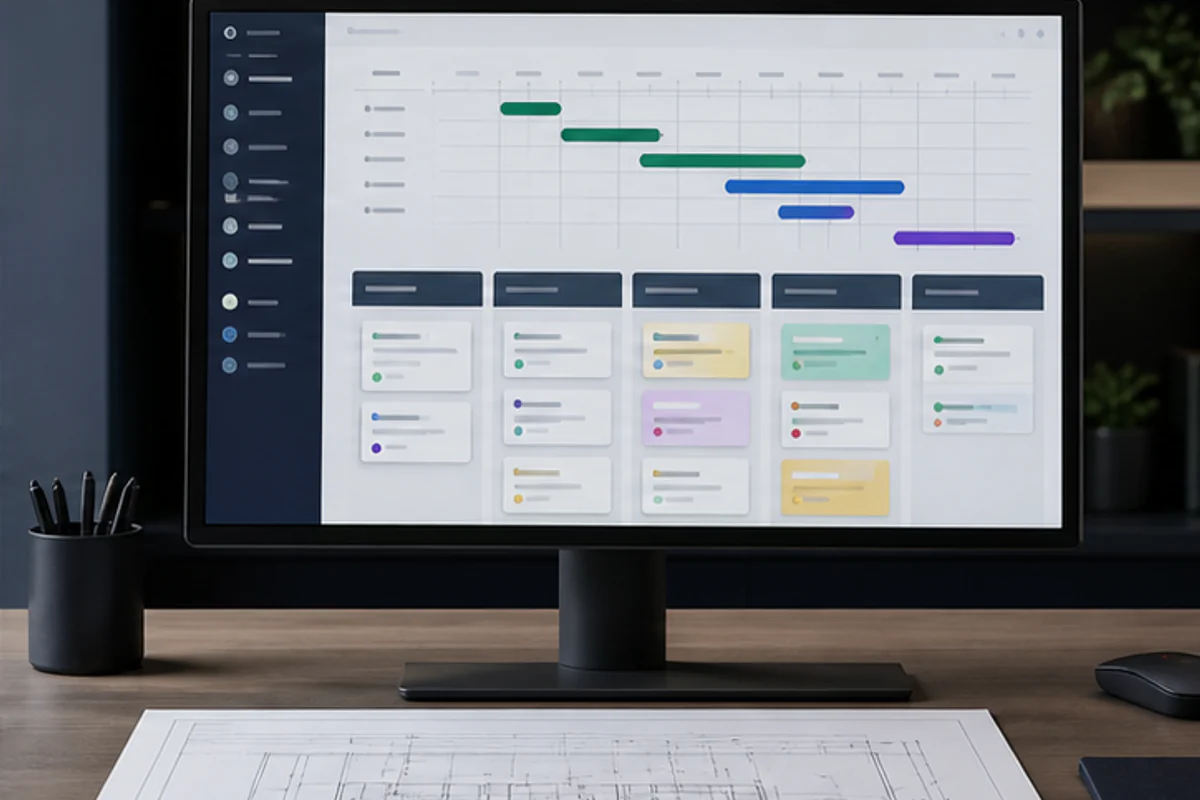
A project tool cannot repair an unclear process, but it can make ownership, dependencies and decisions visible. Selection should begin with how work moves, not with a preferred board, timeline or template. ChoiceVanta uses a decision-first method: define the situation, remove incompatible options, compare the remaining evidence on equal terms and document the trade-offs. This guide contains no paid placement and links only to related ChoiceVanta guidance.
Define the decision before opening a comparison table
Choose one representative project and map intake, prioritisation, assignment, approval, handover and reporting. Identify which system remains authoritative for files, conversations and customer records. A useful brief is short enough to apply consistently but precise enough to reject an option. Write the non-negotiable conditions first, followed by preferences and a total budget. If several people will use or approve the choice, agree on this brief before a trial or purchase.
The first version should capture:
- delivery model
- dependency visibility
- portfolio reporting
- external collaboration
- archive and export
Give each requirement an observable test. Words such as “fast”, “simple”, “secure” or “good value” are not criteria until the team states what would count as success. This prevents marketing language from becoming the scoring system.
Compare the criteria that change the outcome
Planning model
Boards suit flow, timelines expose dependencies and lists support simple execution. The tool should represent the team’s planning method without maintaining the same facts in several views by hand. Build a real plan and change one dependency, owner and deadline to observe how the system responds. Record the result in the same short decision sheet so that attractive but unsuitable options do not return to the shortlist later.
Workload and priorities
Capacity indicators are useful only when estimates, availability and competing work are maintained with reasonable effort. Run a planning session and measure whether the view improves a decision or simply creates more updating. Record the result in the same short decision sheet so that attractive but unsuitable options do not return to the shortlist later.
Reporting
Leaders need trends and exceptions, while teams need actionable detail. Reports should trace back to current work rather than a separate presentation layer. Reproduce a current status report and verify every number against underlying items. Record the result in the same short decision sheet so that attractive but unsuitable options do not return to the shortlist later.
Permissions and collaboration
Clients and suppliers may need narrow access without seeing unrelated projects, budgets or internal discussion. Test guest roles, shared links, notifications and offboarding using a realistic external participant. Record the result in the same short decision sheet so that attractive but unsuitable options do not return to the shortlist later.
Portability and automation
Automations should reduce repetitive work while remaining observable and reversible. Exports need to preserve useful relationships. Disable an automation to inspect failure handling and export tasks, comments, attachments and custom fields. Record the result in the same short decision sheet so that attractive but unsuitable options do not return to the shortlist later.
Test claims against evidence and the normal routine
Vendor templates demonstrate possibilities, not fit. A time-boxed pilot with normal users and a completed retrospective reveals adoption cost and missing controls. Separate a published specification from an independently observed result and from a personal preference. Each can inform the decision, but they answer different questions. Note the date, model or service tier, test conditions and any important limitation. When evidence conflicts, prefer the source that most closely resembles the intended use and explains its method.
A trial should include a normal task, an awkward case and a recovery step. The awkward case reveals limits; the recovery step shows what happens when a connection, account, component or process fails. Do not place sensitive information into a trial environment unless its controls and retention have already been approved.
Account for regional and market differences
Distributed teams must consider time zones, language, data location, support coverage and local employment practices when workload information relates to individuals. Confirm the exact model, plan, seller or provider available in the destination market. Price should be recorded with tax, currency and date. Warranty, consumer remedies, support language, electrical standards and feature availability can change the value of an otherwise identical-looking offer.
Calculate cost over the intended period
Count all collaborators, reporting tiers, integrations, setup, migration, administration and the recurring labour of keeping fields accurate. Complexity has a cost even when a feature is included. Use a realistic period rather than an arbitrary monthly comparison. Record purchase or subscription cost, required accessories, consumables, support, migration, maintenance and a plausible exit cost. Time is also a resource: configuration, training, repeated manual work and difficult support can outweigh a small price difference.
Watch for risk signals
- The tool duplicates an existing system of record. Pause the decision until the claim, responsibility or fallback is documented.
- Reports depend on fields nobody owns. Pause the decision until the claim, responsibility or fallback is documented.
- Automation failures are silent or difficult to reverse. Pause the decision until the claim, responsibility or fallback is documented.
A risk signal does not always disqualify an option. It changes the burden of proof. Ask who owns the risk, how it is detected, what the fallback costs and whether the answer is part of a durable policy or merely a sales conversation.
Use a disciplined shortlist
- Remove any option that fails a non-negotiable requirement.
- Score the remaining criteria with the same scale and written evidence.
- Run the normal, awkward and recovery tests on the strongest candidates.
- Calculate the total cost and regional constraints over the intended period.
- Record the selected trade-off, review date and conditions that would trigger a change.
The final choice should be explainable in a few sentences: what need it serves, what evidence supports it, which limitation was accepted and how the owner will monitor that limitation. This record is more valuable than a generic ranking because it remains useful when products, prices and circumstances change.